
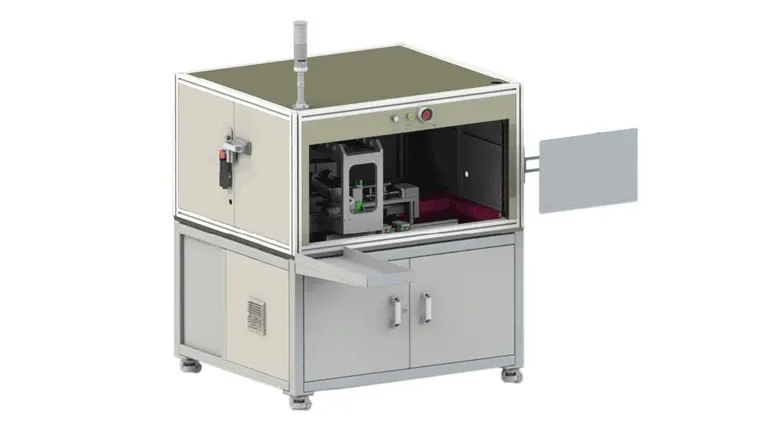
In today's highly competitive photovoltaic industry, improving crystallization yield and reducing production costs are top priorities for every manufacturer. As the “seed” of crystal growth, seed crystal quality directly determines the succ
Vision Potential SC-Seed Seed Crystal Inspection System: Accurately Detect Seed Crystal Hidden Cracks to Protect PV Crystallization Yield
Introduction: Seed Crystal Quality – The First Line of Defense in PV Crystallization
In today's highly competitive photovoltaic industry, improving crystallization yield and reducing production costs are top priorities for every manufacturer. As the “seed” of crystal growth, seed crystal quality directly determines the success or failure of crystal pulling. A seed crystal with hidden cracks, stress concentration, or dimensional deviations can lead to rod breakage, polycrystalline inclusions, or even damage to expensive hot-zone equipment, resulting in economic losses of hundreds of thousands of yuan.
However, traditional seed crystal inspection has long relied on manual visual observation and caliper measurement. Seed crystal hidden cracks are located inside the crystal and are completely invisible to the naked eye. Surface damage in critical areas such as the tapered neck and chamfers is often missed due to viewing angle limitations. Manual code entry is inefficient and error-prone. These “blind spots” and “pain points” have long troubled production managers in crystallization workshops.
Vision Potential, with years of experience in PV vision inspection, has launched the seed crystal inspection system SC-Seed to address these industry challenges. This system integrates infrared imaging, high-precision vision measurement, stress analysis, and automatic identification technology, achieving comprehensive, blind-spot-free, high-precision inspection of seed crystals. It fundamentally solves the limitations of manual inspection and builds the “first line of defense” for PV crystallization quality.
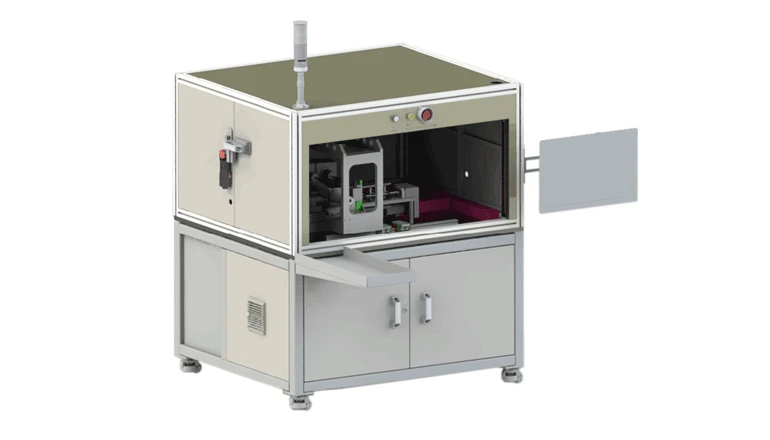
Vision Potential SC-Seed Seed Crystal Inspection System
Chapter 1: Core Pain Point – Seed Crystal Hidden Cracks, the “Invisible Killer” of Crystallization Failure
In PV crystallization processes, seed crystals must withstand enormous thermal and mechanical stresses. If tiny hidden cracks exist inside a seed crystal, these cracks rapidly propagate under high-temperature pulling conditions, causing the seed crystal to suddenly break. The growing crystal ingot then falls, resulting in a “rod break” accident. Rod breakage not only means failure of the current crystallization run but can also contaminate the molten silicon in the crucible and damage the hot zone, forcing the entire crystallizer to shut down for cleaning – at a huge cost.
What makes seed crystal hidden cracks even more challenging is their extreme concealment:
Invisible to the naked eye: Hidden cracks are located inside the crystal and leave no visible marks under normal lighting.
Blind spots in traditional transmitted light: Some systems use single-angle infrared transmission, but the complex shape of the seed crystal's tapered neck creates detection dead zones.
Surface changes before and after acid washing: The reflective properties of seed crystals differ significantly before and after acid washing, making it difficult for traditional light sources to adapt to both states, reducing detection stability.
Additionally, dimensional deviations (large-end diameter, small-end diameter, taper, length) affect mounting accuracy and thermal field matching in the crystallizer. If the code on a seed crystal cannot be accurately read, quality traceability becomes impossible.
Vision Potential's SC-Seed seed crystal inspection system is designed to solve these deep-rooted problems.
Chapter 2: Technological Breakthroughs – Four Core Functions Cover All Inspection Needs
1. Blind-Spot-Free Infrared Defect Detection – Making Hidden Cracks Visible
The SC-Seed uses a high dynamic range infrared line-scan camera (1k) combined with a unique multi-angle imaging solution, completely eliminating the traditional blind spot at the seed crystal's tapered neck. Infrared light penetrates the silicon crystal surface to directly reveal internal structures:
Detectable defect types: Internal hidden cracks, surface cracks, scratches, crescent marks, edge chipping, machining marks, and more.
Detection accuracy: 0.075mm/pixel, far exceeding human eye resolution.
One-click switching for pre/post-acid washing: The high dynamic range camera automatically adapts to changes in surface reflectivity, eliminating the need for manual parameter adjustments.
2. High-Precision Dimensional Measurement – Micron-Level Accuracy
Seed crystal geometry directly affects installation precision and thermal field distribution in the crystallizer. The SC-Seed is equipped with a 5120×5120 ultra-high-resolution dimensional camera paired with a high-collimation optical light source, eliminating edge blurring caused by specular reflection:
Measured parameters: Large-end diameter, small-end diameter, taper, length.
Measurement accuracy: 0.009mm/pixel (approximately 9 microns).
Diameter range: 1-49mm.
Length range: 100mm-300mm.
The high-collimation light source is particularly critical. Conventional light sources produce strong specular reflection when illuminating highly reflective silicon materials, causing “whitened” edges that are difficult to extract. The collimated light source ensures highly consistent light direction, dramatically improving edge contrast for stable and reliable dimensional measurement.
3. Automatic Seed Crystal Code Recognition – End-to-End Traceability
High-quality seed crystals typically have unique codes recording production batches, inspection data, and usage history. The SC-Seed features a 1280×1024 character recognition camera with 0.05mm/pixel accuracy, automatically reading laser-engraved or inkjet codes with high speed and accuracy. With its reserved MES interface, inspection data (defect types, dimensional data, stress distribution, corresponding codes) can be uploaded in real-time to the factory's manufacturing execution system, enabling full lifecycle traceability from incoming material to use, from shipment to scrap.
4. Exclusive Stress Analysis – Predictive Inspection to Reduce Rod Break Risk
This is a core technology that sets Vision Potential apart from competitors. The SC-Seed not only detects “existing” hidden cracks but also analyzes stress distribution inside the seed crystal. Even without visible cracks, stress-concentrated areas are high-risk points for future breakage during crystallization.
Detection principle: Using polarization optical imaging to capture the birefringence effect caused by lattice distortion, enabling quantitative stress distribution analysis.
Application value:
Identifying residual mechanical stress from machining processes (cutting, grinding).
Warning of stress concentrations around hidden cracks.
Helping process engineers optimize seed crystal machining parameters to reduce residual stress at the source.
With stress analysis, crystallization workshops can assess the “health status” of seed crystals before they are loaded into crystallizers, minimizing rod break risk.
Chapter 3: Application Scenarios – Covering the Entire Seed Crystal Lifecycle
Vision Potential's SC-Seed seed crystal inspection system can be deployed at multiple critical points in the seed crystal flow:
01 100% Inspection or Sampling Before Shipment from Seed Crystal Manufacturers
Seed crystal manufacturers can perform 100% inspection or sampling on each batch before shipment, detecting hidden cracks, surface scratches, edge chipping, dimensional deviations, and recording quality data to optimize production processes and improve product consistency.
02 Incoming Seed Crystal Re-Inspection
PV crystallization companies face the risk of new defects generated during transportation and storage. The SC-Seed enables rapid incoming re-inspection, preventing defective seed crystals from entering crystallizers and reducing production risks.
03 Laboratory Seed Crystal Quality Assessment
For R&D institutions, accurate seed crystal quality data directly affects the validation of new materials and processes. The SC-Seed provides quantifiable, reproducible seed crystal quality inspection for R&D laboratories, supporting specialty crystal preparation and new material development.
04 Pre-Production Inspection in Crystallization Workshops
This is the most critical application scenario. Before seed crystals are loaded into crystallizers, the SC-Seed performs rapid, accurate “final check” inspection, ensuring every seed crystal meets process standards and preventing rod breakage, polycrystalline inclusions, and other failures during crystallization.
Chapter 4: Comparative Advantages – Why Choose Vision Potential SC-Seed?
| Comparison Item | Manual Inspection | Conventional Optical Inspection | Vision Potential SC-Seed |
|---|---|---|---|
| Hidden Crack Detection | Impossible | Blind spots (tapered neck) | Blind-spot-free infrared |
| Dimensional Measurement | Caliper, low precision/efficiency | Blurry edges with standard light | High-collimation light + high-res camera, 0.009mm/pixel |
| Stress Analysis | Not available | Not available | Exclusive stress detection |
| Code Recognition | Manual entry, error-prone | Partial support | Auto-recognition + MES interface |
| Pre/Post-Acid Washing Adaptability | Not applicable | Requires repeated parameter adjustment | One-click switching |
| Data Traceability | Paper records, difficult | Partial support | 100k image storage + MES upload |
Chapter 5: Technical Specifications
| Parameter | Specification |
|---|---|
| Model | SC-Seed |
| Infrared Camera | 1k line scan |
| Character Recognition Camera | 1280×1024 |
| Dimensional Camera | 5120×5120 |
| Detectable Types | Hidden cracks, stress, code recognition, dimensional measurement |
| Equipment Dimensions | 128cm × 152cm × 161cm |
| Infrared Detection Accuracy | 0.075mm/pixel |
| Dimensional Measurement Accuracy | 0.009mm/pixel |
| Character Detection Accuracy | 0.05mm/pixel |
| Diameter Detection Range | 1-49mm |
| Length Detection Range | 100mm-300mm |
| Operating Platform | Windows |
| Power Consumption | 800W |
| Input Voltage | AC 220V |
| Computer | Dell |
| Display | 2K touchscreen |
| Image Storage Capacity | 100,000 images |
| Equipment Weight | 160kg |
| Operating Temperature | -30°C ~ 50°C |
| Relative Humidity | ≤85% RH |
Chapter 6: Application Cases – Real Defects, Real Detection
| Defect Type | Detection Description |
|---|---|
| Large-end crescent mark | Infrared image clearly shows crescent-shaped impact marks on the large end, difficult to detect manually |
| Large-end chamfer damage | Tiny damage on the chamfer edge is fully captured by the high-resolution camera |
| Small pit on tapered slope | Micro pits on the tapered neck slope, a traditional blind spot, are imaged without dead angles by SC-Seed |
| Machining marks | Marks left by grinding are clearly visible, aiding process improvement |
| Chamfer crack | Cracks on the chamfer are clearly revealed by infrared imaging, preventing rod break |
Conclusion: Exchange Inspection Precision for Crystallization Yield, Reduce Production Risk with Data Intelligence
As the PV industry transitions from “scale expansion” to “lean manufacturing,” the quality of every single seed crystal matters. Vision Potential, through the SC-Seed seed crystal inspection system, transforms seed crystal hidden crack detection from “unknowable” to “visible,” from “experience-based judgment” to “data-driven decision-making.”
Blind-spot-free infrared detection, micron-level dimensional measurement, exclusive stress analysis, and automatic code recognition – four core technologies fully covering seed crystal quality inspection needs. Whether you are a seed crystal manufacturer, a crystallization company, or a materials laboratory, the SC-Seed provides a reliable, efficient, and traceable seed crystal quality assurance solution.
Seed Crystal Inspection · Blind-Spot-Free · High Precision
Choose Vision Potential. Make every seed crystal pass the test.
Vision Potential, seed crystal inspection, seed crystal hidden cracks, PV crystallization, infrared detection, stress analysis